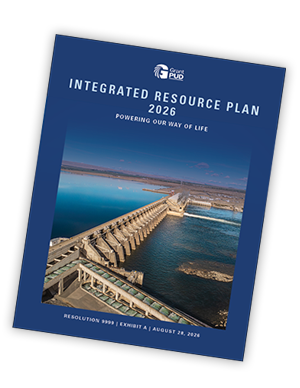
Integrated Resource Plan
Come learn about Grant PUD’s 20-year plan to power the county
Grant PUD will host a public hearing, July 28, to present its 20-year plan for providing service in the most cost-effective way possible by assembling a viable energy portfolio, preserving flexibility, managing costs and reducing exposure to myriad uncertainties.
The 2026 “Integrated Resource Plan (IRP)” is a state-mandated analysis that details how the utility will meet its customers’ demand for electricity. The plan is updated every two years. This analysis covers the years 2027-2046.

Review Materials and Submit Comments
Review Presentation Materials from June 23, 2026 meeting.
Review draft of Integrated Resource Plan Section 1*
*This is a preliminarily draft executive summary and the final version will be reviewed and approved by our commission on Aug. 25, 2026.
To submit public comment click the button below or email: publicaffairs@gcpud.org.

Integrated Resource Plan Project Timeline
June 23 2026
Public Workshop
Draft materials will be presented to commission. Public comment period opens.
June 23 2026
July 28, 2026
Public IRP Hearing
Commission will hear public comments
Aug. 25, 2026
Commission Resolution Review
Aug. 25, 2026
The IRP is a state-mandated, forward-looking analysis of how utilities plan to meet their customers’ demand for electricity in the most cost-effective way, while meeting the state’s clean-energy goals.
Under RCW 19.280.030, utilities with more than 25,000 customers that do not receive their power from the Bonneville Power Administration must create a 20-year-IRP at least every four years and submit a progress report every two years.
The 20-year planning window holds much uncertainty, amid rising asset costs, variable weather conditions, transmission availability, clean-energy mandates, evolving markets and customer needs for electricity. Some of these factors are hard to forecast annually, much less 20 years out.
First, because state law requires we create a 20-year plan. Second, variables and uncertainties are always part of the challenge. By their nature, plans are formulated with incomplete information. We build our IRP around a range of plausible futures, not any single future. We want to reduce bad surprises by identifying risks and coming up with a plan that performs reasonably well across many possibilities.
Work to create the 2026 IRP began in January 2025. It’s an internally driven, truly cross-functional effort involving 16 working groups, including District analysts, forecasters and energy market specialists, as well as staff from Large Power Solutions (Grant PUD’s larges customers), External Affairs and communications, Finance, Rates and Pricing, Transmission Business Services and Transmission Planning. This edition of the IRP also has a budget of $100,000 for externally contracted analysis. It’s a major effort.
Grant PUD customers and other members of the public help by telling us what’s most important for your families and businesses. Your fresh perspectives and suggestions help keep us on track and our planning successful. Don’t be shy about reaching out.
Grant PUD will not run out of power. Energy demand in Grant County has already grown beyond the capacity of our Columbia River dams, Priest Rapids and Wanapum to supply it during summer and winter months. Demand will continue to grow. The IRP forces us to think ahead to be sure we comply with state law in assembling the energy resources we need to supplement our hydropower to ensure we have what we need to keep the lights on.
Grant PUD buys and sells energy at the Mid-Columbia trading hub in the Northwest to balance periods when our generation exceeds our local demand or when additional power is needed. Grant PUD’s federal license to operate our dams also requires that about one-third of the hydropower we generate be made available to the broader regional market.
When Grant PUD has surplus energy, it sells into this market. Buyers may move the power to other states, such as California, for economic reasons. Historically, those buyers have been willing to pay higher prices for Grant PUD’s carbon-free hydropower, because even with a premium, it remained cost-effective compared to alternatives. This allows Grant PUD to benefit from increased revenues that help keep local electric rates lower. As demand within Grant County grows, however, periods of surplus generation are expected to become less frequent over time.
Staff will present a final IRP for commission adoption Aug. 25, 2026. Grant PUD must submit the IRP to the state Department of Commerce before the Sept. 1, 2026 deadline.